
I try to learn something new every day. Often that information isn’t actually sought out by me. It just arrives at my door and falls into my lap. It is most welcome.
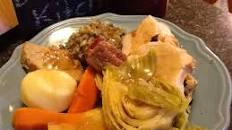
Recently our family – being me and wife Judy, our three sons and their families – sat down to salt beef, potatoes, cabbage, and turnip for Sunday dinner. We also had carrots and pudding. I grew up on that. I know the taste from our Sunday dinner table in the west end of St. John’s. Actually, it is the same table my family today sits around three quarters of a century later. We always had on Sunday what we called then a “cooked dinner.” The late broadcaster Randy Snow reminded me of that some years ago. He came from a family half a province away on the west coast and they also called the Sunday meal a “cooked dinner.”
I recently encountered the phrase “Jiggs dinner” in print. I thought it originated in our distant past from the late 18th or early 19th century and that it was an old Newfoundland expression. I thought it was a reference to something ancient in our past that it had something to do with the ocean. I was wrong.
It turns out “Jiggs dinner “comes to us from an American cartoon strip called Bringing Up Father. It was known to many as “Maggie and Jiggs” after the central characters. The Bringing Up Father strip of the Nov. 7, 1922 edition of The Evening Telegraph includes a riff that says the dish is a favourite of Jiggs, the main character of the series. The popularity of the comic associated the dish to the character. By the 1920s and 1930s, “Jiggs dinners” and “Jiggs suppers” were used to advertise fundraising events in Newfoundland, with the assumption that the reader knew the name. It turns out we Newfoundlanders weren’t the only people in the world to have salt beef, potatoes, cabbage, and turnip for Sunday dinner. Lots of other people did.
I could be wrong but the list of ingredients all share something in common. None of them requires refrigeration. That leads me to a new line of thinking and that is recipe comes from Ireland and spread to Newfoundland and “the Boston states” and other places as well. I might mention that many immigrants came to the United States from Ireland but first stopped for a generation or so in Newfoundland. Famous Boston criminal Whitey Bulger was of a family that came first to Newfoundland before settling near Boston. That group of immigrants were known in New England as “two boat Irish.” So much for Jiggs Dinner as an exclusively Newfoundland dish.
Another interesting piece of information came to me some years ago from writer/historian Jack Fitzgerald. I had long been interested in a piece of music from the Royal St. John’s Regatta that isn’t Up The Pond. The other piece is called Garryowen, and it was a favourite of the ill-starred American General George Armstrong Custer who died with all his men of the First Cavalry at the Little Big Horn. A substantial number of those men were Irish. Now, I thought Garryowen may have been brought to Newfoundland by Irish immigrants the same as it had been brought to the United States and even other parts of Canada. Again, I was, as I often am, out to lunch. Jack Fitzgerald told me the song came to our Regatta by way of American bands from Fort Pepperell playing at the Regatta. That’s how we found it and not by way of any complicated immigration pattern that flowed from The Great Famine. An American military band gave it to us.
You can contact Jim Furlong at jfurlong@ntv.ca